

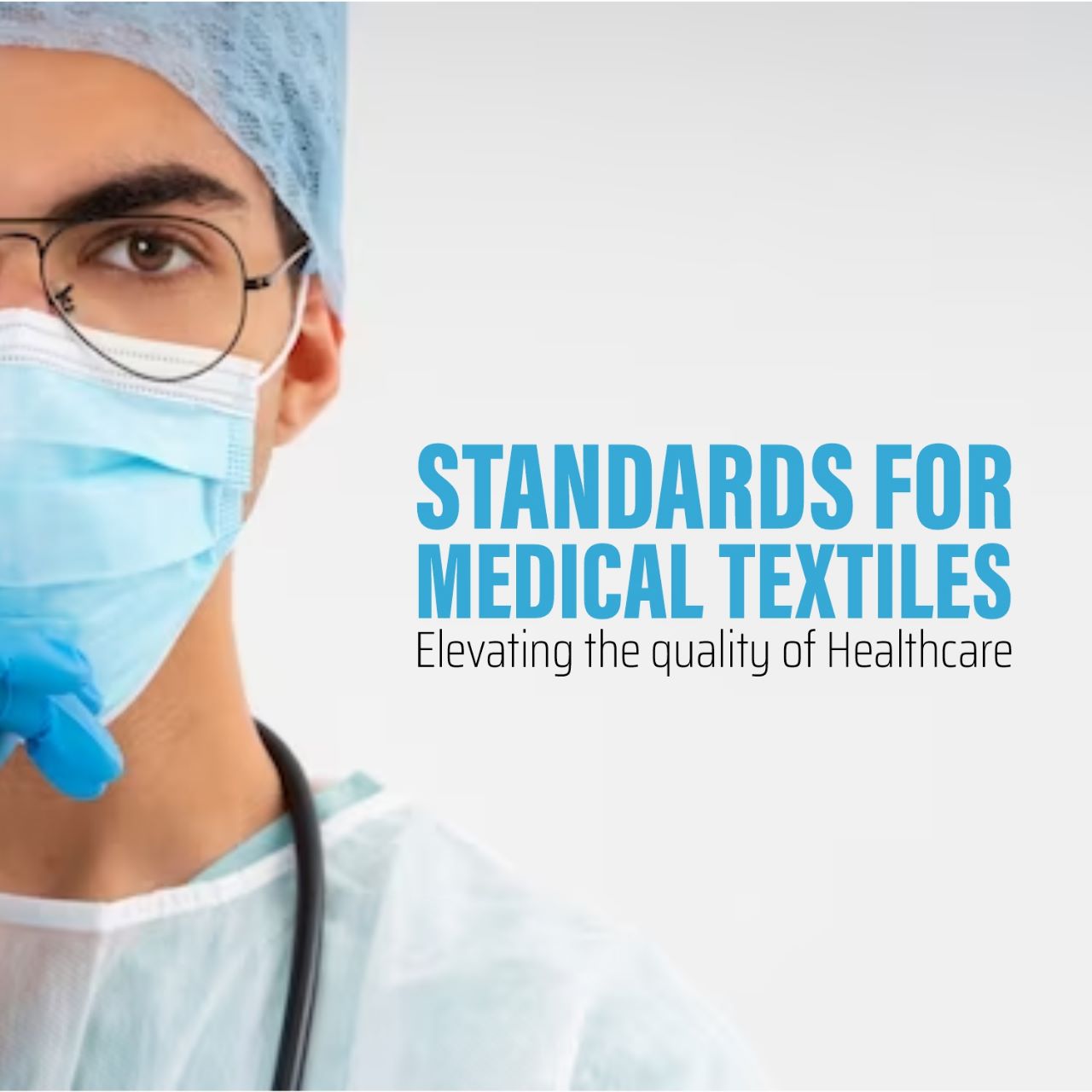
Medical textiles are mainly used for protection from infections in hospital environment, personnel hygiene, wound treatments, wound closure, replacement surgery or as a mechanical organ. Some of the examples of medical textiles are surgical masks, bio-protective coverall, surgical gown and drape, disposable sanitary pad, reusable sanitary pad/period panties, baby diapers, caps, wipes, sutures, bandage, artificial lung etc.
Standardization in the field of Medical Textiles has been undertaken by Technical Textiles for Medtech Application Sectional Committee, TXD 36 under Textiles Division Council with mandate to formulate Indian Standards for terminology, testing and specifications for technical textiles for medtech applications such as healthcare and hygiene textile products, implantable and non-implantable and extra corporeal textile products.
1) IS 17423 : 2021, Medical Textiles — Bio-Protective Coveralls — Specification (First Revision)
Coverall is a type of personal protective equipment (PPE) intended to be worn by healthcare personnel for the purpose of isolating all parts of the body from a potential hazard. The bio-protective coveralls provide protection against various biological agents due to their material sealing arrangement.
To ensure the safety, comfort and quality of Bio-protective coverall for healthcare professional, BIS has published IS 17423 (single use and reusable) which specifies the important performance requirement such as resistance to synthetic blood penetration, resistance to viral penetration, breathability, tensile strength, seam strength, cleanliness – microbial, resistance to dry microbial penetration and biocompatibility etc.
2) IS 16289: 2014 ‘Medical Textile — Surgical face masks — Specifications’
Surgical face mask is a medical device covering the mouth, nose and chin providing a barrier to minimize the direct transmission of infective agents between staff and patient.
The key performance requirements specified in IS 16289 Surgical Facemask include Bacterial filtration efficiency and Sub-micron particulate filtration efficiency at 0.1 micron for safety, Differential pressure for comfort, splash resistance to protect from blood and body fluids during surgery.
The surgical masks have been categorized into three classes based on the barrier performance properties of the surgical face mask materials (fluid resistance, bacterial filtration efficiency, and sub-micron filtration efficiency, splash resistance), i.e., Class 1, Class 2 and Class 3.
3) IS 5405 : 2019, Sanitary Napkins — Specification (Second Revision)
Sanitary napkin is an absorbent material used to absorb fluid discharged during menstruation. As compared to cloth and other materials (husks, ashes, etc.) used during menstruation, it provides better hygiene and protection against leakage.
The important quality requirements specified in this standard are
i) The pH test requirement ensure that the product is comfortable to the user.
ii) The ability to withstand pressure after absorption test ensure that the product can meet the absorbency requirement without leakage.
iii) Hygiene testing which includes testing of Bacterial and Fungal Bioburden and test for common skin pathogen — Staphylococcus Aureus ensure that the product is safe from harmful bacterial and skin pathogen.
iv) The Biocompatibility Evaluation covering Cytotoxicity, Irritation and Skin Sensitization tests ensure that raw material used for manufacturing the final product are safe for user based on its known toxicological characteristics at intended use.
v) The optional requirements of Biodegradability and Compostability ensure that the product is biodegradable/compostable which reduce the unnecessary burden of solid waste generation in the environment.
4) IS 17509 : 2021, Disposable Baby Diaper — Specification
Baby diapers are personal hygiene products that allows the baby to defecate or urinate without the use of a toilet, by absorbing or containing waste products to prevent soiling of outer clothing or the external environment. On the basis of the weight of infant and/or toddler the baby diapers are classified into new born, small, medium, large, extra-large.
The important quality requirements specified in this standard are pH value, rate of absorption, rewet under load, minimum absorption capacity, hygiene testing requirement, biocompatibility evaluation, phthalate test, and optional requirement for biodegradability and compostability, etc.
This standard also covers the types and sizes and requirement for fastening and securing mechanism of the baby diaper.
5) IS 17334 : 2019, Medical Textiles — Surgical Gowns and Surgical Drapes — Specification
Surgical gowns and surgical drapes are intended to be used to minimize the transmission of infective agents between patients and clinical staff during the surgical and other invasive procedures. This standard addresses the performance of surgical gowns and surgical drapes designed to protect against exposure of healthcare workers to blood, body fluids, and other potentially infectious materials during surgery and other healthcare procedures.
The following important performance requirements have been covered in this standard for surgical gowns and drapes:
Impact penetration (g)
Hydrostatic resistance (cmwc)
Blood resistance and viral resistance
Particle release
Tensile strength and bursting strength (dry and wet)
Resistance to microbial penetration – dry and wet
Biocompatibility evaluation (cytotoxicity and irritation sensitization)
To ensure the comfort, requirement for moisture vapour transmission rate has also been specified for level 3 gowns
Written By:
Shri J K Gupta
Scientist E & Head Textiles
Shri Dharmbeer
Scientist C, Textiles