

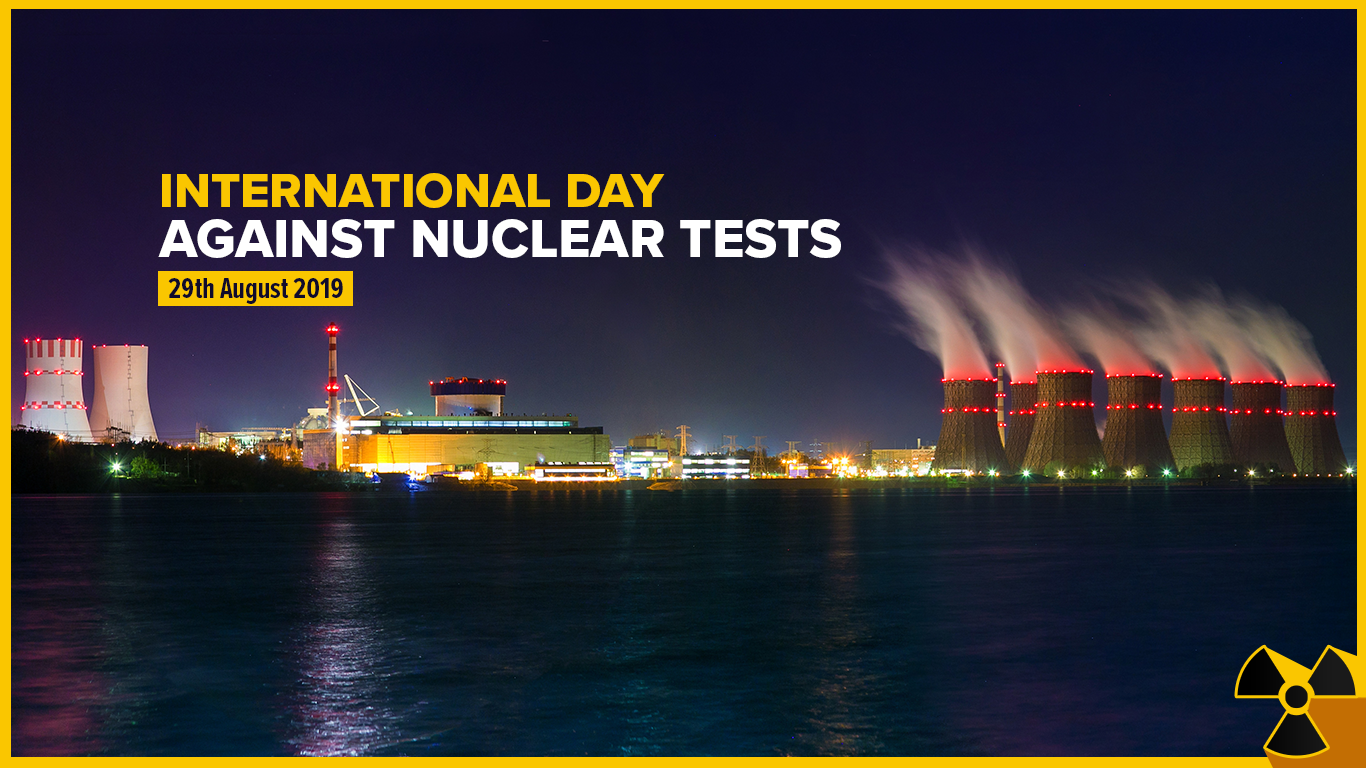
The International Day against Nuclear Tests is observed on 29th August every year. The decision of observing this day was marked on 2nd December 2009 at the 64th session of the UN General Assembly to increase awareness about the effects of nuclear weapons testing or any other nuclear explosions. It also focusses on the need for terminating such nuclear tests as a step towards creating a world free from the clutches of nuclear weapons.
The initiative for observing a day against nuclear tests was first initiated by the Republic of Kazakhstan along with a good number of sponsors and co-sponsors with an outlook to commemorate the closure of the Semipalatinsk Nuclear Test site. This nuclear test site was decommissioned on 29 August 1991.
Start of the Nuclear Age
The first nuclear test was conducted on 16th July 1945 and since then nearly 2000 such tests have been conducted all over the world. Traditionally, the nuclear tests were designated to atmospheric explosions. There have been hazardous and tragic effects due to these nuclear tests, which are further compounded by the nuclear outcomes from atmospheric tests.
To reduce these adverse effects, nuclear testing countries have adapted methods like underground testing, underwater testing, and exoatmosphere testing. However, even these testing methods come at a cost. While underground testing majorly affects the bio-organisms of the soil, underwater testing affects marine life.
Can Nuclear Tests be terminated?
Over the years, nuclear tests have resulted in a substantial amount of damage and impact on the environment, food security, and economic development of the areas near test sites. Although the world is aware of the damages caused due to these nuclear tests, can it really be terminated?
Considering the rate at which the nuclear countries are developing and the world is shaping out to be, it is practically impossible to terminate such nuclear tests. Though the frequency of conducting nuclear tests can definitely be decreased, stopping them altogether is not feasible. Nuclear weapon tests are essential to measure the efficiency and impact of nuclear weapons, especially for military use.
Keeping that in mind, a considerable amount of measures for nuclear safety has come into effect now. One such measure has been defined by the Bureau of Indian Standards under the code – IS 16692.
What is IS 16692?
This Indian Standard is adopted from ISO 2889:2010. The standard sets a performance-based criterion and recommendation for the design of systems for the sampling of airborne radioactive materials that are present in the effluent air from the ducts and stacks of nuclear power areas. Such recommendations and requirements are aimed at conducting sampling for regulatory compliance and system control.
In case an existing air sampling system is not designed on the requisites of the IS 16692 norm, an evaluation of the performance is opined. If any deficiency is examined, a determination of whether a retrofit is needed or not is recommended. The compliance of criteria or recommendations of IS 16692 is required under normal and off-normal conditions. However, the Indian standard also recommends a special or separate air sampling system for accidental conditions.
In essence, this standard helps in ensuring sampling of radioactive substance for tests without any dispersion of harmful radioactive substances and explosions into the environment. It helps in monitoring the concentration and activity of radioactive substances into the air.
There are some other Indian Standards, compliance of which is helpful in Nuclear Industry:
Nuclear Safety Governance in India
With 6 nuclear tests to its name, India ranks 7th amongst the most powerful nuclear power countries in the world. India has always been very particular about the ‘no first use’ doctrine and strictly adheres to this. Adding to this, the Department of Atomic Energy (DAE) under the Government of India has ensured safety regulations and norms that help in ensuring the accurate measures to be taken during a nuclear test, whether it is a weapon testing, site mechanism or emergency. There is also an emergency response system created by DAE to handle any radiation emergency that occurs in the public domain in the locations where there is no DAE facility.
What is clear by now is that nuclear tests cannot be terminated as they are necessary to maintain the safety and efficiency of the nuclear weapons that are essential for the military governance and security of the countries. But, strict measures and steps have to be taken to ensure that the effects of such nuclear tests are minimal on the environment.

Written By: Shrishti Dixit, Scientist ‘C’, CHD
Go Back