

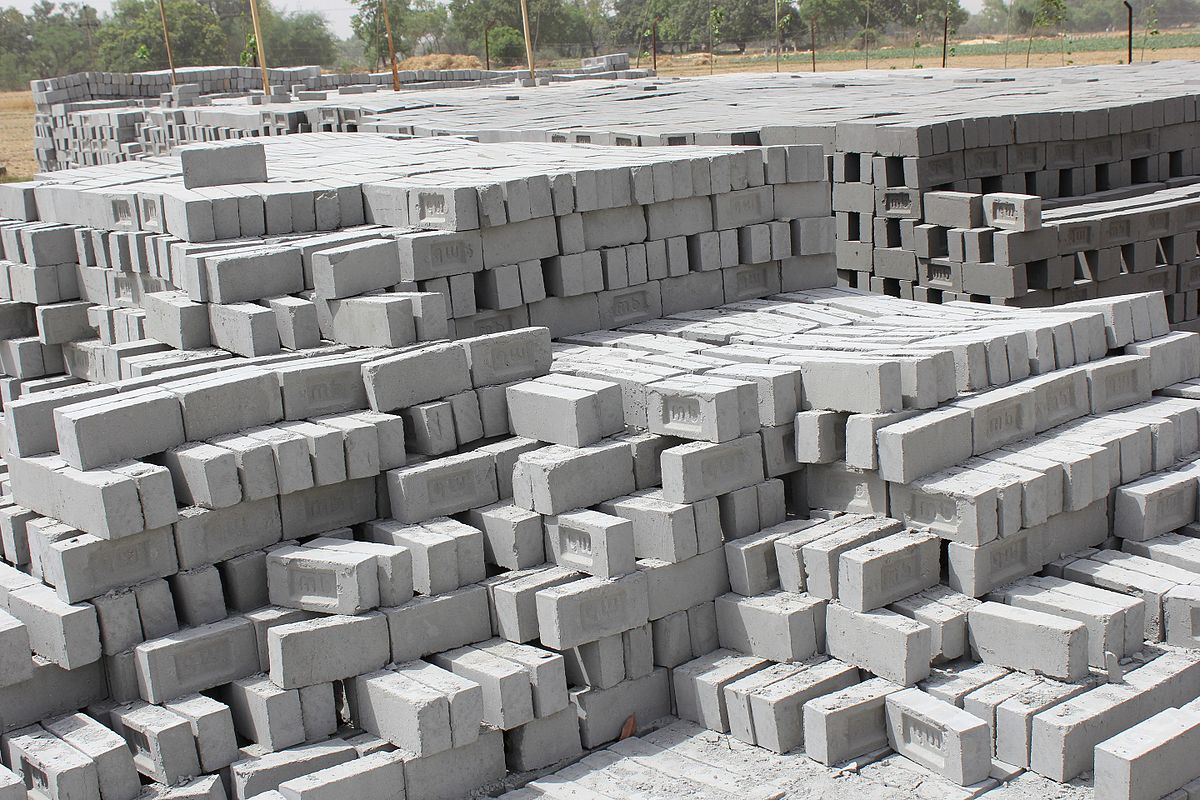
Pulverized fuel ash is a by-product of using pulverized coal as fuel from thermal power stations. This national resource can be gainfully utilized to manufacture pulverized fuel ash-cement bricks as a supplement to standard burnt clay building bricks leading to the conservation of natural resources and improvement in environmental quality. Pulverized fuel ash-cement bricks are made from pulverized fuel ash in significant quantities, cement, and other ingredients. These bricks are manufactured by mixing various raw materials, which are moulded into bricks when sufficiently hardened and then subjected to curing. While cement is used as binder, in the process, the calcium hydroxide liberated during the hydration of cement reacts with the pozzolanic portion of pulverized fuel ash in the presence of moisture resulting in secondary hydrated mineralogy akin to those of cement hydration which gives additional strength to bricks.
Pulverized fuel ash-cement bricks are suitable for use in masonry construction, just like standard burnt clay bricks. Production of these bricks has already started in the country. This standard would help in quality control and encourage their production and use on a mass scale. This standard lays down the essential requirements of pulverized fuel ash-cement bricks to achieve quality and uniformity in manufacturing such bricks.
Significance Of Pulverized Fuel Ash-Cement Bricks
Pulverized Fuel Ash-Cement Bricks are significant in the construction industry due to several reasons:
1. Eco-Friendly: These bricks are made using the waste material of coal-fired power plants, reducing the amount of waste in the environment.
2. Cost-effective: These bricks are cheaper than traditional bricks as they use waste material, reducing the cost of production.
3. Durability: These bricks are highly durable and long-lasting, making them ideal for construction.
4. Strength: The addition of cement makes the bricks strong and able to withstand the rigors of construction.
5. Insulation Properties: The ash content in the bricks provides insulation properties, making the buildings more energy-efficient.
6. Aesthetics: The light color of these bricks provides a natural and aesthetically pleasing appearance to the buildings.
Indian Standard Covering Pulverized Fuel Ash-Cement Bricks
IS 16720: 2018 is a specification standard for pulverized fuel ash-cement bricks. This Indian Standard was released by the Bureau of Indian Standards (BIS) on September 2018. The standard specifies the requirement for pulverized fuel ash-cement bricks’ physical and mechanical properties.
The bricks are made from a mixture of pulverized fuel ash and cement and are widely used in constructing walls, partitions, and pavements. They are a cost-effective and environmentally sustainable alternative to conventional clay bricks.
The standard covers the following aspects of pulverized fuel ash-cement bricks:
1. Materials: The specification sets out the requirement for the quality of pulverized fuel ash and cement used in the production of the bricks. It also specifies the requirement for the quality of other materials such as Chemical Admixtures, Aggregates Additives, and Water.
2. Manufacture: A detailed disruptive guidance is provided in this standard for the manufacturing of the fly ash bricks, which includes the procedure of Mixing, Placing, Compaction, and Curing.
3. Dimensions: The standard specifies the dimensions for modular as well as non-modular sizes of bricks, which include the length, width, height, and tolerance limits.
4. Compressive Strength: The specification sets out the minimum 28-day wet compressive strength requirement of the bricks, which varies from 5 to 15 N/mm2.
5. Water Absorption: The standard specifies the maximum water absorption of the bricks, which specify that bricks shall not have average water absorption more than 20 percent by mass up to class 10, and 15 percent by mass for higher classes.
6. Density: The standard specifies the density of the bricks, which stipulates that bricks shall have a density between 1 100 kg/m3 and 2 000 kg/m3.
7. Test Methods: The standard provides the methods for determining the physical and mechanical properties of the bricks.
8. This standard also provides the sampling, conformity criteria, and the bricks’ marking detail.
Using Pulverized Fuel Ash-Cement Bricks in construction is beneficial because of its sustainability, cost-effectiveness, durability, strength, insulation, and aesthetics. In order to maintain the standards of these bricks BIS introduced IS 16720: 2018, a specification standard
The IS 16720: 2018 standard is an essential reference for the manufacturers and suppliers of pulverized fuel ash-cement bricks and for the builders and construction professionals who use them. It ensures that the bricks produced meet a minimum level of quality, durability, and performance and are safe for use in construction.
डॉ मनोज कुमार रजक / Dr. Manoj Kumar Rajak
वैज्ञानिक-डी / Scientist-D
सिविल इंजीनियरिंग विभाग / Civil Engineering Department
भारतीय मानक ब्यूरो / Bureau of Indian Standards
S. Hudson Singh
वैज्ञानिक-डी / Scientist-D
सिविल इंजीनियरिंग विभाग / Civil Engineering Department
भारतीय मानक ब्यूरो / Bureau of Indian Standards