

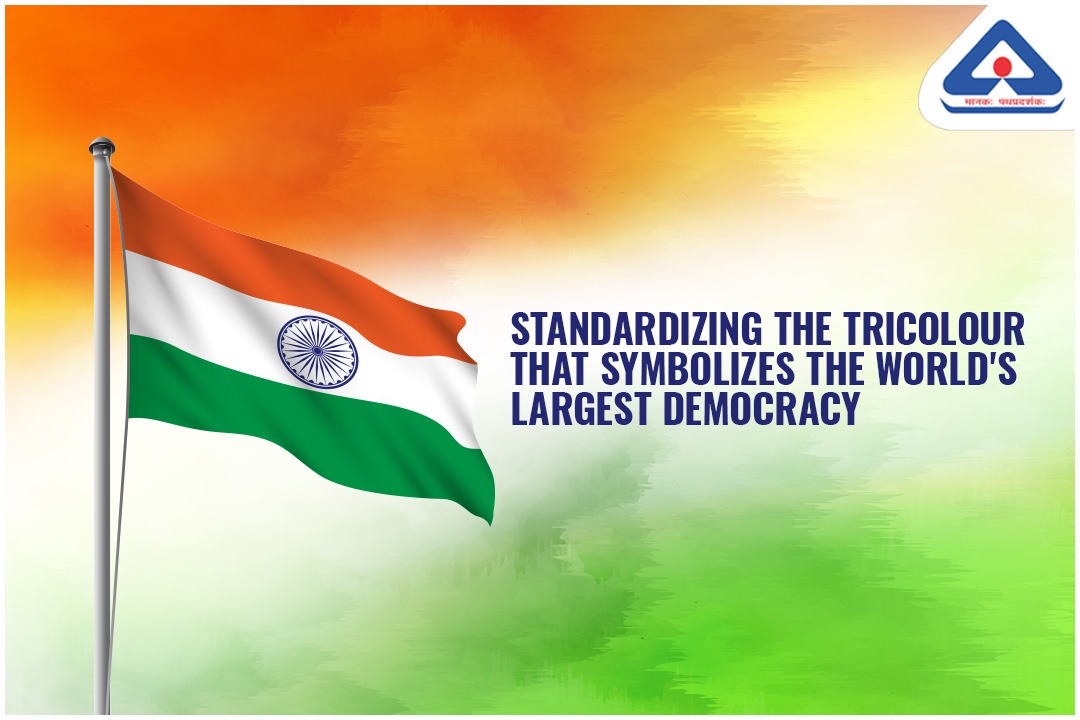
As history goes, it was Gandhi who first proposed the flag to the Indian National Congress in 1921 which was designed by Pingali Venkayya. In the center was a traditional spinning wheel, symbolizing Gandhi’s goal of making Indians self-reliant by fabricating their own clothing. The present national flag of India which symbolizes the world’s largest democracy is based on the aforementioned ‘swaraj’ flag and was adopted on 22nd July 1947.
The flag is a horizontal tricolour of deep saffron (Kesaria) at the top, white in the middle and deep green at the bottom in equal proportion. The ratio of the length of the flag to its width is 3:2. In the center of the white band is a navy-blue wheel with 24 equally spaced spokes which represents the Ashoka Chakra and is that of the wheel which appears on the abacus of the Sarnath Lion Capital of Ashoka. It is also interesting to note that the flag which represents and complements the rich and varied heritage of India is also standardized by the Bureau of Indian Standards by publishing an Indian Standard for them.
Usage of the flag is governed by the Flag Code of India and other laws relating to the national emblems. The original code prohibited the use of the flag by private citizens except on national days such as Independence Day and the Republic Day. In 2002, on hearing an appeal from a private citizen, the Supreme Court of India directed the Government of India to amend the code to allow flag usage by private citizens. Subsequently, the Union Cabinet of India amended the code to allow limited usage. The code was amended once more in 2005 to allow some additional use including adaptations on certain forms of clothing. The flag code also governs the protocol of flying the flag and its use in conjunction with other national and non-national flags.
Significance of the colours
The saffron colour on the top indicates the strength and courage of the country. The white middle band indicates peace and truth with ‘Dharma Chakra’, while the green at the bottom shows the fertility, growth, and auspiciousness of India.
A peek at the past
The design of the national flag was adopted by the Constituent Assembly of India on 22nd July 1947 and the First National Standard on National Flag was published as IS 1 in 1951 by the National Flag Sectional Committee of erstwhile ISI. This standard was revised in 1964 with a view to change the dimensions in the metric system completely. In 1968, the Indian Standard was again revised to make major changes wherein the details of yarn for warp and weft of cotton khadi bunting and of cotton khadi duck were deleted. The dimensions of hemp cordage and those of wooden toggles used for different sizes of flags were amended. Further, the pH value of the aqueous extract of bunting and tolerances on the dimensions of the flag and Ashoka Chakra were prescribed. Flexibility in the length to width ratio of the flag i.e., 3:2 for special purpose requirements was also allowed.
Thus, the Indian Standard (IS 1:1968) prescribes the design, constructional details and the other particulars of the national flag made of hand-spun and hand-woven cotton khadi bunting. This standard specifies different sizes of national flags depending on their length and width as mentioned below;
Dimensions of the flag
| Flag Size Number | Length | Width |
| 1 | 6300 | 4200 |
| 2 | 3600 | 2400 |
| 3 | 2700 | 1800 |
| 4 | 1800 | 1200 |
| 5 | 1350 | 900 |
| 6 | 900 | 600 |
| 7 | 450 | 300 |
| 8 | 225 | 150 |
| 9 | 150 | 100 |
It is also important to note that the Ashoka Chakra shall preferably be screen printed, or otherwise printed or stenciled or suitably embroidered with navy blue colour embroidery thread. In all the cases, the chakra shall be completely visible on both sides of the flag in the center of the white panel.
Written by:

J K Gupta,
Scientist – D