

Electricity is integral to our lives. It powers our homes to workplaces, factories to farms, and technology transport. Electrical energy makes our homes livable and comfortable. Electricity flows 24X7 to light up our homes and keep various utility appliances active.
Now, friends, what is electricity? The flow of charges in a conductor is defined as electricity. We get this magical current at the flick of a switch or a push of a button. But, electricity flows with caution, and it says, handles me with care. Hence, safety is a significant concern.
And here, Indian Standards come into the picture and play a vital role in ensuring safety. Therefore, it’s the consumer’s responsibility, like you, to lay down cables and wires and install switches and sockets according to BIS standards.
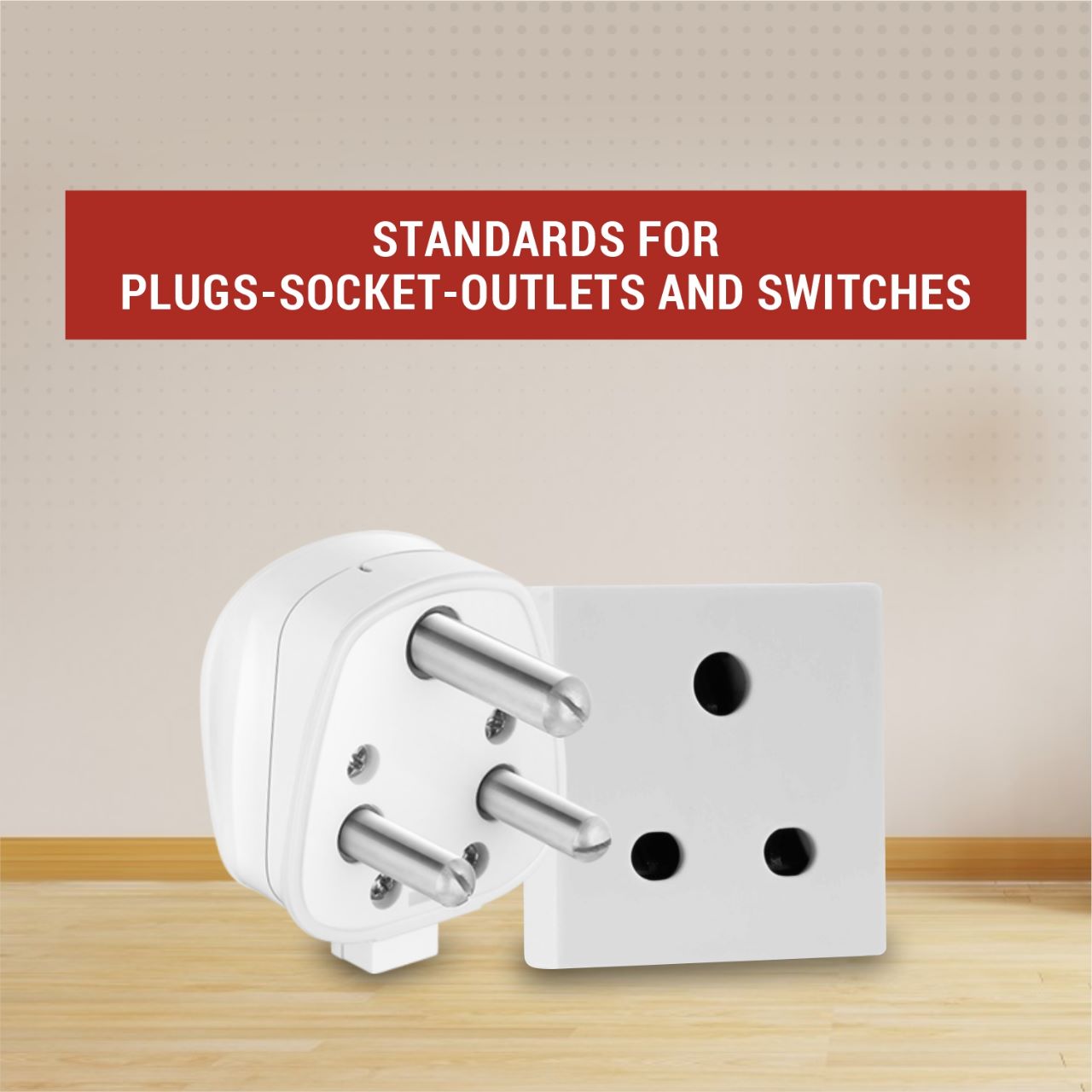
Plugs and sockets connect electrical equipment to the main power supply in buildings and other sites. Switch is used to complete or break an electric circuit to use an electric appliance according to our convenience. These devices look small but are vital components of electrical installations to ensure safety.
IS 1293 and IS 3854 ensure the quality of plugs & socket-outlets, and Switches, respectively, by prescribing detailed quality parameters as per their use and roles.
Socket outlets may be fixed, portable, multiple, or combined. Further, these are classified according to the provision for earthing, the method of connecting the cable, the degree of protection against electric shock, the existence of shutters, and the class of appliances to which they are intended to be connected.
Let’s learn about the quality characteristic of plugs & socket-outlets, and Switches and the method to test the same:
a) Provision for earthing
Earthing is used to protect you from an electric shock. It provides a low-impedance path for a fault current to flow to the earth. IS 1293 ensures that the current-carrying pins shall separate while withdrawing the plug before the earth connection is broken.
Similarly, for switches, IS 3854 ensures that accessible metal parts are connected to the earth terminal to protect from shock in case they become live.
b) Protection against electric shock
IS 1293 ensures that metal pins are not exposed to a human when the plug is inserted into the socket. Touching the metal pins during use may give an electric shock. The finger test is defined in the Standard for compliance.
Similarly, IS 3854 ensures that when switches are installed or wired, live parts are not accessible.
c) Dimensions
Why standardization of dimension is important- Interoperability, since appliances and manufacturers use different designs of plug-tops, but at the same time, IS 1293 ensures the proper operability of plugs and sockets to prevent loose connection and, therefore, to spark.
Another important aspect is- Interchangeability. As per norms, higher-rating plugs shall not be inserted into the lower-rated sockets. IS ensures the same.
d) Resistance to Abnormal Heat and to Fire
This clause of the Standard ensures that in case of abnormal heat (due to overloading) and fire (due to lose connection), the insulation material of the product does not deteriorate, and fire shall not start.
e) Mechanical strength
Plugs- sockets, and switches shall have the adequate mechanical strength to withstand the stresses imposed during installation and use. Compliance is checked by applying blows by means of the pendulum hammer apparatus.
f) Normal operation
Plugs- sockets, and switches shall withstand the mechanical, electrical, and thermal stresses occurring in everyday use without undue wear or other harmful effect. Compliance is checked by inserting and withdrawing plugs into sockets 10000 times.
g) Mechanical Strength
Plug-sockets and switches are manufactured from both thermoset and thermoplastic materials. As these materials have different properties, therefore Indian Standard ensures the minimum requirement of mechanical strength. It is checked by applying blows by means of the pendulum hammer apparatus. It provides the durability of the product.
Written by:
Neha Agarwal
Scientist ‘C’
ETD