

Hallmarking of Gold Jewellery & Artefacts
Since ancient times gold is considered a storehouse of value in India. In villages, people invest in gold to keep them secured against inflation and to be able to raise loans by mortgaging it in a time of need.
Gold is too soft to withstand wear, therefore, for jewellery making, gold is always alloyed with some other metal. The need for alloying of gold also makes the public extremely vulnerable to excessive adulteration. Detection of adulteration in gold is difficult without performing technical tests.
It was in this background that the Government of India took cognizance of the need for protecting consumers. A mandate was, therefore, given to the Reserve Bank of India (RBI) Standing Committee on Gold and Precious Metals to look into the issues relating to the Standardization of Gold products and the introduction of Gold Hallmarking in the country. The Committee identified the Bureau of Indian Standards (BIS) in the year 2000 as the sole agency to operate the Hallmarking Scheme in India and entrusted BIS with the task of implementing the hallmarking scheme to protect the consumer against cheating, develop export competitiveness and make India a leading market for gold jewellery in the world.
What is Hallmarking
Hallmarking is the accurate determination and official recording of the proportionate content of precious metal in the jewellery/artefacts or bullion/coins.
Mandatory Hallmarking of gold jewellery/artefacts was successfully implemented, vide Hallmarking of Gold Jewellery and Gold Artefacts Order, 2020, in 256 districts of the country with effect from 23 June 2021. The Second phase of mandatory hallmarking was implemented in 288 districts from 01 June 2022 vide Hallmarking of Gold Jewellery and Gold Artefacts (Amendment) Order, 2022, dated 04 April 2022.
At present the mandatory hallmarking regime covers six caratages of gold jewellery/artefacts viz. 14, 18, 20, 22, 23 and 24 carats as mentioned in the Indian Standard IS 1417-Gold and gold alloys, jewellery/ artefacts — fineness and marking —specification.
It is mandatory for a jeweller to get registered with BIS for selling hallmarked jewellery. BIS registered jeweller submits the jewellery for hallmarking to BIS recognized Assaying & Hallmarking (A&H) centre. A&H centres are the testing centres where the jewellery is tested and which operate in accordance with IS 15820:2009- General requirements for establishment and operation of Assaying and Hallmarking centres. After testing, the A&H centre applies hallmark on the jewellery which is found to meet the requirement of the Indian Standard, IS 1417:2016.
Introduction of HUID
Under the voluntary scheme of Hallmarking, all the jewellery pieces sent to an AHC had to be hallmarked, but the Hallmark on each of the pieces was the same: BIS logo, purity, AHC mark and Jewellers mark. This system was prone to be misused; hence, it was decided to automate the functioning of the AHCs and introduce a new system of Hallmarking wherein the Hallmark to be laser-marked on a piece of jewellery has a six-digit alphanumeric code generated by the system. This six-digit alphanumeric code is referred to as HUID. BIS has developed a digital solution wherein the entire workflow in the assaying and hallmarking centre is maintained online and can be monitored on a real- time basis. At the end of the testing, a unique HUID code is generated from the BIS server for each jewellery article and is laser marked by the assaying and hallmarking centre on the jewellery along with the BIS logo and purity mark.
Before 1 July 2021 hallmarked Jewellery consisted of the following four marks:
BIS Mark
|
Purity in carat and fineness for gold (e.g.22K916,18K750, 14K585 ) |
Assay centre’s identification mark/number | Jewellers identification mark/number |
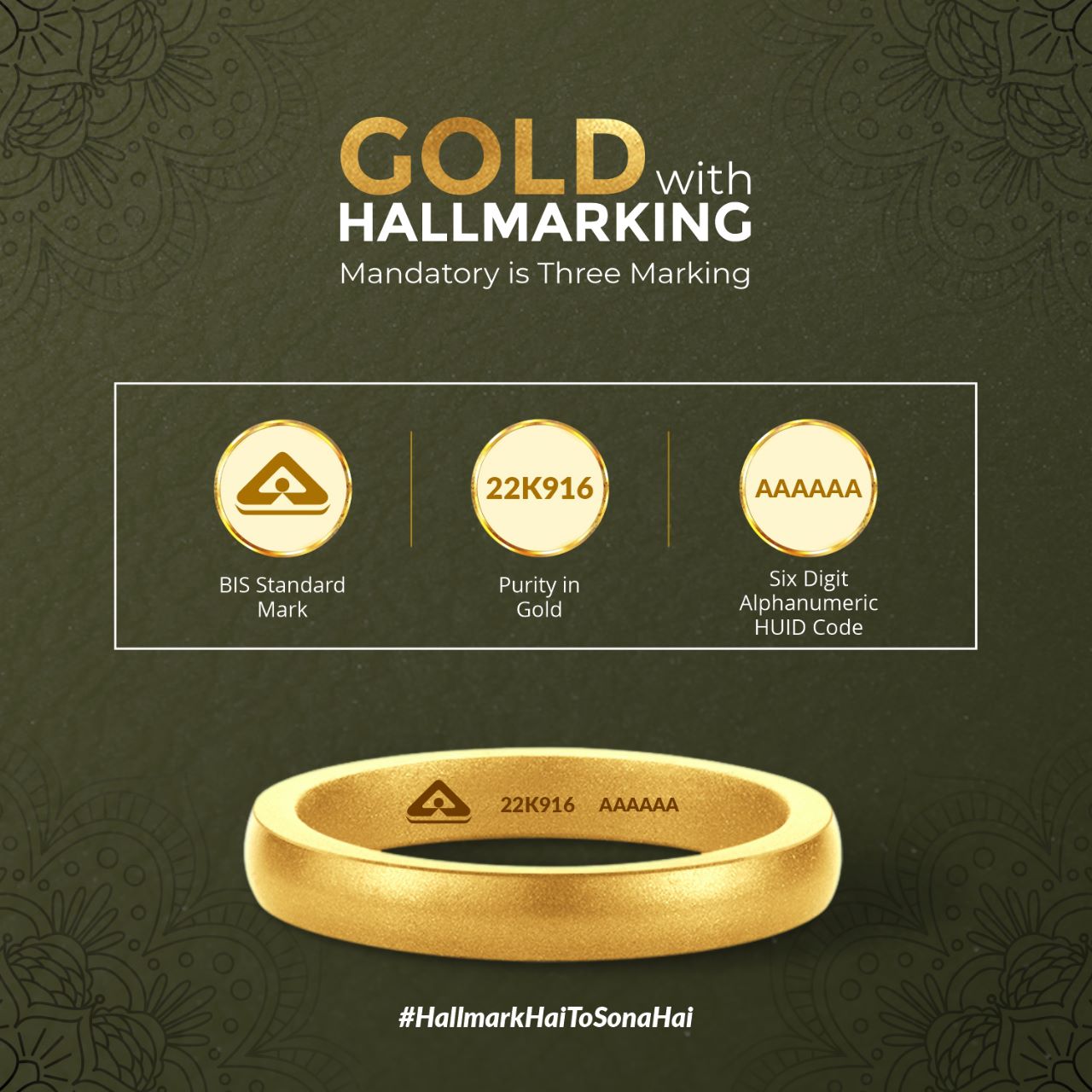
With the introduction of six digits alphanumeric HUID code from 1 July 2021, the four marks have now been replaced by three marks for gold jewellery/ artefacts as given below:
| BIS Mark
|
Purity in carat and fineness for gold (e.g.22K916,18K750,14K585,20K833, 23K958, 24KS995) | Six-digit alphanumeric code AAAAAA |
Consumers can use the “Verify HUID” feature in the BIS Care mobile application to verify the authenticity of Hallmarked gold jewellery items bearing a HUID number.
Hallmarking charges for the jewellery are – Rs.45/- per piece for gold jewellery irrespective of the weight of the jewellery.
Growth of Hallmarking Scheme in India
The implementation of mandatory hallmarking of gold jewellery has garnered encouraging responses from all quarters. As of date, more than 1.4 lakh Jewellers are registered with BIS while more than 1300 BIS-recognized AHCs are operative in the country. While hallmarking was voluntary, within a year maximum number of hallmarked jewellery was 4.49 crore (2018-2019). However, after hallmarking became mandatory, more than 14 crore gold jewellery has been hallmarked with HUID in the period from 1st July 2021 till date. It is envisaged that the ambit of mandatory hallmarking will be extended to every district of the country in the near future.
For more information, please visit our website www.bis.gov.in.
Written By
Mr. Sanjay Goswami,
Scientist F & Head, Hallmarking Department
Mr. K Chandan Rao,
Scientist B, Hallmarking Department