

The International Day for the Preservation of the Ozone Layer, also known as World Ozone Day, is celebrated on the 16th of September every year. The theme for World Ozone Day 2018 is “Keep Cool and Carry On”.
OZONE LAYER
The Ozone layer present on Earth’s stratosphere is a shield which protects us from harmful ultraviolet rays. It is a made of ozone gas that is naturally present in the atmosphere. This layer stretches for about 20-30 km from Earth’s surface, and is essential to support all forms of life on Earth.
At any given time, ozone molecules are constantly formed and destroyed in the stratosphere. When chlorine and bromine atoms come into contact with ozone in the stratosphere, they destroy ozone molecules. In fact, one chlorine atom can destroy over 100,000 ozone molecules before it is removed from the stratosphere. The fact that ozone can be destroyed more quickly than it is naturally created, adds to this concern.
Some compounds release chlorine or bromine when they are exposed to intense UV light in the stratosphere. These compounds contribute to ozone depletion, and are called ozone-depleting substances (ODS). ODS include chlorofluorocarbons (CFCs), hydrochlorofluorocarbons (HCFCs), halons, methyl bromide, carbon tetrachloride, hydrobromofluorocarbons, chlorobromomethane, and methyl chloroform. ODS are generally very stable in the troposphere and only degrade under intense ultraviolet light in the stratosphere. When they break down, they release chlorine or bromine atoms, which then deplete ozone. Although ODS are emitted at the Earth’s surface, they are eventually carried into the stratosphere through a process that can take as long as two to five years.
EFFECTS OF OZONE DEPLETION
‘Ozone hole’ is caused by depletion of the protective ozone layer in the stratosphere over Earth’s polar region. This leads to melting of polar caps, and subsequently a rise in sea level. In addition to this, following are some of the harmful effects caused due to ozone depletion:
Human health
Plant health
Aquatic ecosystems/ Marine life
Biogeochemical cycles
GENESIS
The Montreal Protocol on substances that deplete the ozone layer is considered as one of the most successful international treaties designed to protect the ozone layer. This is being done by phasing out the production of numerous substances believed to be responsible for ozone depletion.
The treaty was originally signed on 16 Sept, 1987. 197 countries have ratified the Montreal Protocol, making it the first international environmental treaty to achieve complete ratification. It has been further strengthened through 6 amendments since its inception.
The United Nations General Assembly on 19 December 1994, declared September 16 as the International Day for the Preservation of the Ozone Layer in commemoration of the Montreal Protocol.
AIM
The Montreal Protocol is phasing out ODS used in sectors such as refrigeration, air-conditioning, aerosols, foam blowing, certain solvents and fire suppression. Global phasing out of CFC and halons has been completed, and HCFC is underway.
HCFCs were introduced as an alternative to CFC. Although being considerably low on ozone depleting potential (ODP), they have a high global warming potential (GWP) up to 2000 times that of carbon dioxide.
KIGALI AMENDMENT
The Parties to the Montreal Protocol reached an agreement at their 28th Meeting on 15 October 2016 in Kigali, Rwanda to phase-down hydrofluorocarbons (HFCs).
Around 197 countries, including India, China and the USA, agreed at Kigali to reduce the use of HFCs by roughly 85% of their baselines by 2045. The Kigali Amendment which amends the 1987 Montreal Protocol aims to phase out HFCs, a potent greenhouse gas by the late 2040s.
The Kigali Amendment will enter into force on 1 January 2019, provided that it is ratified by at least 20 Parties to the Montreal Protocol (or 90 days after ratification by the 20th Party, whichever is later).
IMPLICATIONS OF KIGALI AGREEMENT ON INDIA
Indian industries using HFCs like Air-Conditioning industry, Automobiles, and refrigeration industry have some serious implications on financial and technical fronts:
WHAT NEXT AFTER HFCs?
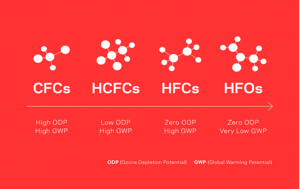
The answer is hydrofluoro olefin (HFO) refrigerants, and the reasons for that are: –
SOLUTION
Alternatives to HFCs should be explored which include substances such as hydrocarbons, ammonia and carbon dioxide which are widely available, safe, approved and on the market. Super-efficient, cost-effective cooling technologies are also being developed, which can help protect the climate both through reducing HFCs emissions and by using less energy. Grants for research and development of affordable alternatives to hydro fluorocarbons is the most immediate priority. It now needs to encourage institutions and industry to participate through time-bound programmes to develop alternative refrigerant gases that will not harm the planet.
INDIAN STANDARDS IN COMPLIANCE WITH MONTREAL PROTOCOL
Indian standards specifying requirements for frost free and direct cool refrigerators, adhere to regulations of MoEFCC in pursuance to measures taken under the Montreal Protocol.
Taking cognizance of the suggestion put forward by MoEF for developing Indian Standards on natural refrigerants, the Refrigeration and Air Conditioning Sectional committee has taken up the responsibility for the same, and initiated work on formulation of Indian Standards on natural refrigerants, such as Ammonia (NH3) for cold storages, which is under the safety group (B2L) of refrigerants, and Propane (HC 290) in air conditioning, which is under the safety group of (A3) of refrigerants.

Written By: Khushbu Jyotsna Kindo, Sc ‘B’ (MED)
Go Back
Comments
Title : 2 thoughts on “World Ozone Day”
Thanks for the great post
It works very well for me