

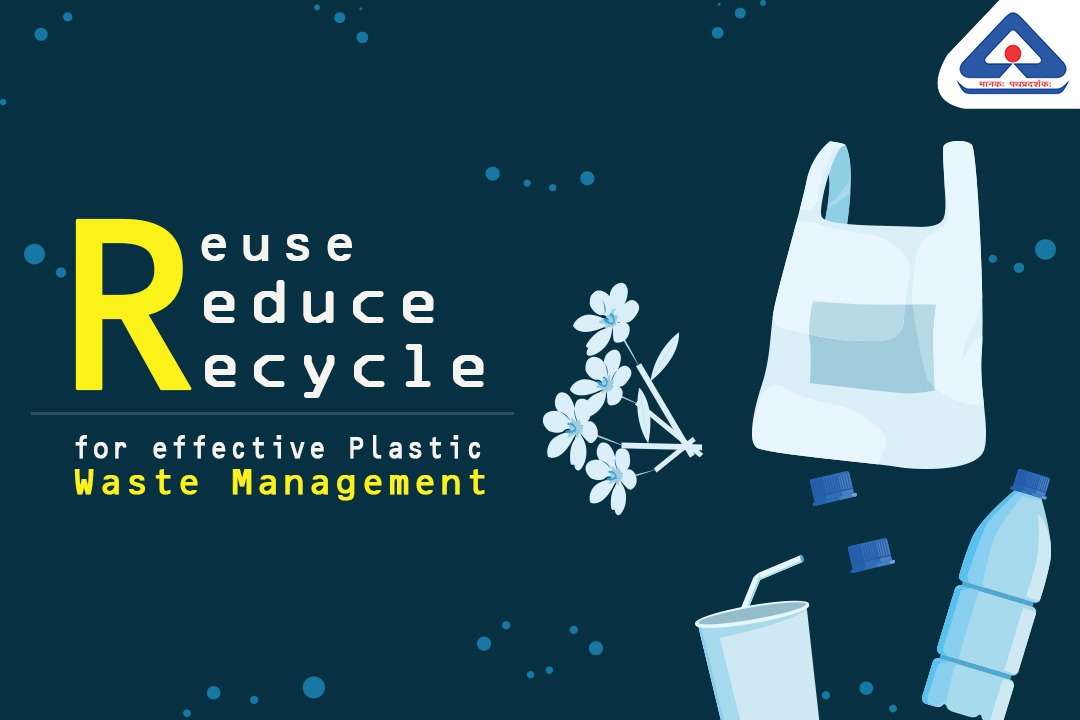
It goes without saying that plastics are an integral part of our daily lives. Their indubitable presence is seen across our world due to their low cost, versatility and durability among others. However, over the years it has dawned upon us that plastic waste is jeopardizing our environment at an alarming rate as its non-degradable. To combat this issue, the “3 R s” – Reduce, Reuse, Recycle stance can be a solution though only in a measurable proportion.
To address the growing concern over the accumulation of plastic waste, the Bureau of Indian Standards (BIS) has published 2 significant standards – ISO 14534 and ISO 14535. The former prescribes guidelines for the selection, segregation and processing of plastic waste while the latter is intended to identify and classify the recycled plastics on the basis of their basic properties and applications. This standard applies to recycled plastic material ready for normal use without further modifications. However for effective Plastic Waste Management (PWM) there is an imperative need for creating awareness to follow its rules and standards. Due to changing lifestyles, an increase in income levels, rising population and the consequent high demand for plastics, the Indian plastic industry is growing by leaps and bounds. The growth rate of the industry in India @ 16% per annum is one of the highest in the world compared to China and the UK.
Plastic waste is generally categorized by pre-consumer plastic waste and post-consumer plastic waste. While pre-consumer plastic waste is likely to be the main source of plastics suitable for reprocessing from manufacturers of plastic products, the real challenge lies with the disposable of post-consumer waste released after residential, industrial and commercial uses.
Coming to the aforesaid term“3 R s” i.e. Reduce, Reuse, Recycle, reduction of plastics can be achieved through a better choice of container size, little or no packaging and use of alternative bio-degradable materials. Reuse of plastics can be through effective implementation of innovative methods such as using refillable containers etc. at the same time by keeping the caution factor in mind. Recycling is probably the most promising method of plastic waste management. The key steps involved are the collection, segregation, processing of plastic waste and proper utilization of recyclates.
It may be noted that the world is moving from Linear Economy i.e. “Take, Make, Dispose’ to Circular Economy which employs certain important aspects such as regeneration, the substitution of material, reuse, restoring optimization and recycling.
So how is India contributing towards effective plastic waste management? The answer lies in the fact that the Government of India has launched the ‘Swachh Bharat Abhiyan’ which is also intended to educate the multitude regarding the proper handling and disposable of plastic waste. Under this mission, the Swachh Bharat Abhiyan committee has formulated various Indian standards which would help in the effective use of recyclates. Another positive step is the formation of Plastic Waste Management Rules, 2016. Under the rules, the minimum thickness of plastic carry bags needs to be 50 microns. Further, manufacture and use of non-degradable, multi-layered plastic should be phased out in 2 years’ time.
Needless to say, the Plastic Waste Management Rules 2016 and Indian Standards on the recycling of plastics are well in place. It is up to us, the citizens of India to act on a war footing to help in plastic waste management and as far as possible keep plastics at bay.
Written by:
Vijay Kumar Gupta
Scientist C
Petroleum, Coal & Related Products Department (PCD)
Comments
Title : One thought on “A plastic smile at our environment can make it frown”
Very good Guptaji