

As a newly emerging field, Geotextile holds enormous potential in varied areas of applications globally. Geotextiles are among the most versatile and cost-effective ground modification materials. That is why their use expands rapidly into vast areas of civil, geotechnical, environmental, coastal and hydraulic engineering. Their worldwide usage for transportation applications, in particular, has been phenomenal.
Geotextile fabrics have five fundamental functions – separation, filtration, drainage, reinforcement and protection. They refer to permeable fabric or synthetic material, woven or non-woven, which can be used with Geotechnical engineering material.
The following geotextile products find extensive applications in various geotechnical engineering activities:
1. Geocells:
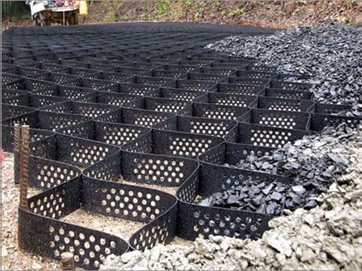
Geocells are a three-dimensional, permeable, polymeric (synthetic or natural) honeycomb or similar cellular structure made of linked strips of geosynthetics to form a confinement system when filled with compacted soil, aggregate and plain cement concrete.
Geocells are fabricated from extruded and textured polymeric HDPE sheets that are UV- stabilized with carbon black and cut into strips. These strips are ultrasonically welded together in alternate intervals and series.
BIS has published IS 17483 (Part 1) and IS 17483 (Part 2) respectively, for Geocells used for load bearing and Slope Erosion Protection applications:
a) IS 17483 (Part 1) specifies material properties and specifications required for the use of high-density polyethylene (HDPE) geocells for load-bearing applications such as flexible pavements, reinforcements in railways, basal reinforcements below reinforced soil structures, conventional embankments on weak soils and industrial flooring and shallow foundations etc.
Fig.1 Geocells for load bearing application
b) IS 17483 (Part 2) specifies material properties and specifications required for the use of high-density polyethylene (HDPE) geocells for slope erosion protection applications such as highway and railway embankments slope, earthen embankments, landfill closure slopes, line slope protection including, supplying and laying as per the design and drawing specifications.
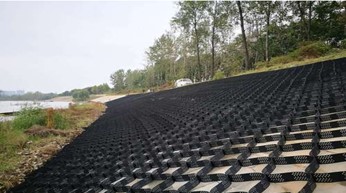
Fig.2 Geocells for slope erosion protection application
The important performance requirements specified in IS 17483 (Part 1 & 2) include seam peel strength per 25 mm of cell depth, seam weld hang strength, environmental stress crack resistance, retention of breaking strength after 500 h UV exposure, friction efficiency, standard oxidative induction time and high-pressure oxidative induction time.
Geocells used for load bearing application must have a minimum cell wall thickness of 1.6 mm at a pressure of 2±0.01 kPa whereas, geocells used for slope erosion protection application must have a cell wall thickness of 1.2 mm at a similar condition.
2. Geogrid
Geogrids are single or multi-layer materials usually made from extruding and stretching high-density polyethylene or polypropylene or by weaving or knitting and coating high-tenacity polyester yarns or glass fibre with appropriate coating. The resulting grid structure possesses large openings called apertures that enhance interaction with the soil or aggregate. The high tensile strength and stiffness of geogrids make them effective as soil and aggregate reinforcement/stabilization.
BIS has published IS 17371: 2020 and IS 17373: 2020 for geogrids respectively used for flexible pavements and reinforced soil retaining structures.
a) IS 17371: 2020 Geosynthetics — Geogrids for Flexible Pavements — Specification
This standard specifies material properties and specifications required for geogrids to be used as reinforcement /stabilization in base, subbase and subgrade in designing flexible pavement structures.
This standard covers, five types of PET Geogrids having ultimate tensile strength of 30 kN/m, 40 kN/m, 50 kN/m, 60 kN/m, 80 kN/m, 100 kN/m respectively in machine and cross direction and 3 types of PP Geogrids having ultimate tensile strength of 20 kN/m, 30 kN/m, 40 kN/m.
The performance requirements specified in this standard include ultimate tensile strength, tensile strength at 2 and 5 per cent strain (in machine and cross direction), Retained tensile strength after 500 h UV exposure and after 72 h chemical immersion and Junction strength.
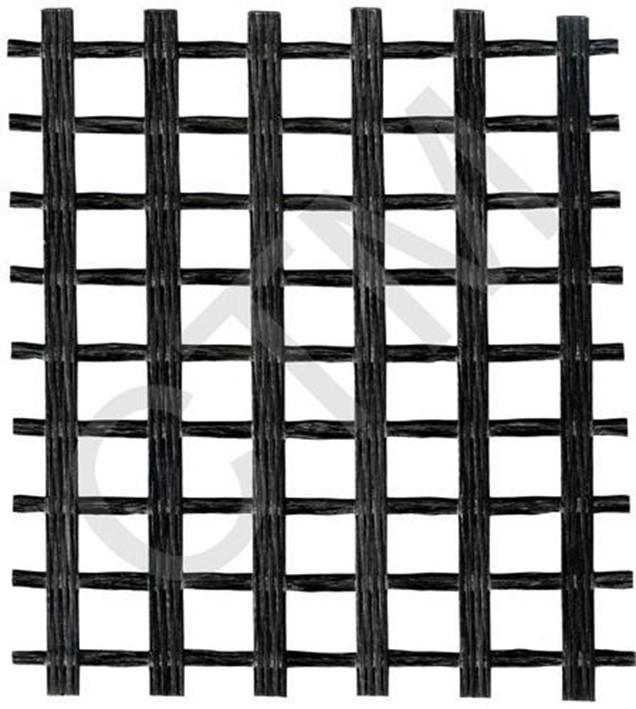

b) IS 17373: 2020 Geosynthetics – Geogrids Used in Reinforced Soil Retaining Structures – Specification
This standard specifies material properties and specifications required for geogrids used as reinforcement in the design of Reinforced Soil Walls (RSW) and Reinforced Soil Slopes (RSS).
This standard covers three types of geogrids:
i) Type 1 — Polyester knitted or woven geogrids having tensile strength in machine direction up to 400 kN/m with aperture size in machine direction and cross machine direction from 10 to 50 mm.
ii) Type 2 — Polyester bonded geogrids having tensile strength in machine direction up to 200 kN/m with aperture size in machine direction from 50 to 500 mm and cross machine direction from 10 to 100 mm.
iii) Type 3 — Polyester bonded geogrids having tensile strength in machine direction up to 1 300 kN/m with aperture size in machine direction from 50 to 1 000 mm and cross machine direction from 50 to 200 mm.
The important performance requirements include ultimate tensile strength (in machine and cross direction), Elongation at designated load, Retained tensile strength after 500 h UV exposure and 72 h chemical immersion.
3. Geostrap:
Geostraps are suitable for a large range of soil reinforcement applications, usually with concrete, steel or other material-facing panels.
BIS has published the following standard on Polymeric strip/geostrip for reinforcement application in Reinforced Soil Walls (RSW) and Reinforced Soil Slopes (RSS):
IS 17372: 2020 Geosynthetics – Polymeric Strip/Geostrip used as Soil Reinforcement in Retaining Structures – Specification
This standard specifies material properties and specifications required for geostrip used as reinforcement in the design of Reinforced Soil Walls (RSW) and Reinforced Soil Slopes (RSS).
In this standard 9 types of Geostraps have been covered having Ultimate tensile strength of 20 kN, 30 kN, 37.5 kN, 40 kN, 50 kN, 60 kN, 75 kN, 85 kN, 100 kN.
The important performance requirement specified in the standard includes Ultimate tensile strength, Retained tensile strength after 500 h UV exposure and Retained strength after 72 h chemical immersion.
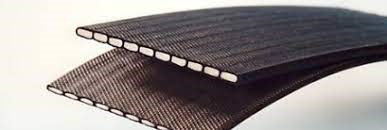
Fig. 5 Geostrap
Written By:
Shri J K Gupta, Scientist E & Head Textiles
Shri Himanshu Shukla, Scientist B
Comments
Title : One thought on “Geosynthetics”
Nice to read your blog. if you are looking for geotextile=>click here