

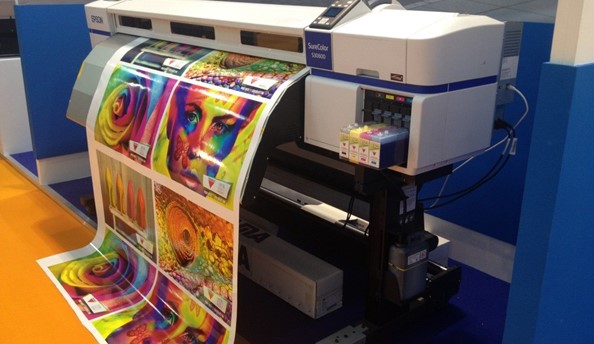
INTRODUCTION TO PRINTING
Printing is supposed to be the most innovative invention of mankind amongst all inventions which has helped in transforming humans to build the modern society we are living in today. In fact printing can be also termed as the mother of all inventions and technologies because printing helped to secure knowledge by printing all documents and spreading them to masses and also secured the technology and knowledge for the future. Printing has been used to transfer not only itself but it has also helped in transferring knowledge to the people through centuries and thereby helped in developing all modern technologies that we are using today. The development of modern society is solely the product of transferring knowledge and creating systems like printed currency which helped in creating systems/policies to actually run the world. Printing is not just technology but it’s also an art. The combined effect of technology and art can be seen through the influence printing puts on our daily lives and today we cannot live our day without printing.
DEFINITION OF PRINTING
Any script or creative that is transferred and replicated onto any flexible or rigid surface for mass production can be termed as ‘PRINTING’.
PREFACE TO PRINTING MACHINERY
It refers to all those machines and equipments, which are used in the field of printing industry. It ranges from small printers to big offset printing machines. Today, the printing machinery is available in various technologies and sizes to suit different needs. Bigger sizes of printing machinery are also available for heavy-duty printing useful for high production at high speed.
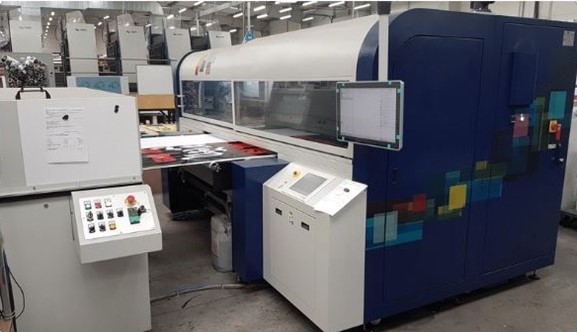
Types of Printing Machines
These are the different types of printing machines:
Digital printers;
Ink-jet printers;
Screen printers;
Embossing machines;
Flexographic printing machine;
Letterpress printing machines;
Offset printers;
Laser printers;
Wireless printers;
3D printers;
Thermographic printers;
Electrostatic printing machine;
Pad Printers; and
Rotogravure printing machines.
SAFETY HAZARDS IN PRINTING MACHINERY
During the operation and maintenance of the machines, worker/operator may be exposed to the following electrical and mechanical hazards, if suitable safety guards or safety devices are not provided:
Being drawn into in-running nips of rollers;
Contact with dangerous moving parts;
Uncovered electric connections;
Entanglement with rotating parts; and
Safety alarms and safety/emergency switches.
NEED OF SAFETY CODES/STANDARDS
Movement of machine parts, electric energy, sharp edges, heat, noise, chemicals, etc, may create hazards for worker/operator, while operating the printing machine. All these above hazards cannot be avoided by design measures because of the functional requirement of the machine/mechanism and hence safety measures are required to protect the operator from these hazards.
The role of safety codes/standards become important for providing procedures/guidelines to the manufacturer while designing their machines and to operator also while operating the machine.
STANDARDS ON SAFETY ASPECTS OF PRINTING MACHINERY
Standardization in the field of printing machinery has been a long drawn programme beginning right from late fifties till present day. Bureau of Indian Standards through its Printing Machinery Sectional Committee, MED 25 has formulated 17 standards on printing machinery and components covering terminology, dimensions, and performance, maintenance and safety requirements.
Some of the major standards formulated by MED 25 on safety requirements in printing machinery are as follows:
| IS/ISO No. | IS Title |
|---|---|
| IS 12619 : 2022 | Printing industry safety code (first revision) |
| IS/ISO 12643-1 : 2009 | Graphic technology — Safety requirements for graphic technology equipment and systems Part 1 General requirements |
| IS/ISO 12643-2 : 2010 | Graphic technology — Safety requirements for graphic technology equipment and systems Part 2 Prepress and press equipment and systems |
| IS/ISO 12643-3 : 2010 | Graphic technology — Safety requirements for graphic technology equipment and systems Part 3 Binding and finishing equipment and systems |
| IS/ISO 12643-4 : 2010 | Graphic technology — Safety requirements for graphic technology equipment and systems Part 4 Converting equipment and systems |
| IS/ISO 12643-5 : 2010 | Graphic technology — Safety requirements for graphic technology equipment and systems Part 5 Stand — Alone platen presses |
KEY PROVISIONS OF IS 12619: 2022 (PRINTING INDUSTRY SAFETY CODE)
This standard specifies the safety requirements applicable to all types and sizes of printing industry ranging from small scale to large scale industries engaged in either the total process of paper printing or part thereof.
In this standard only the safety requirements relevant to specific plant and machinery involved in printing industry, such as foundry, photolitho, printing machines, cutting and binding machines have been enumerated. Other general safety requirements for building, electricity, fire-fighting arrangements, effluents and environment control, etc, as applicable to any other industry shall have to be in compliance with Factory Regulation Act, 1948, prevailing in respective states where they are located.
Some of the important safety requirements covered in the standard are as follows:
1. Mechanical Safety Guards:
a) Interlocking guards with guard locking (Guards cannot be opened without a tool);
b) Interlocking guards without guard locking (If guards are opened the machine will stop); and
c) Mechanical safety guards (Without interlocks) (To be positioned in such a way no part of the human body gets dragged into the rotating nip).
2. Hold-to-run Control Devices:
Control devices, which initiate and maintain the operation of parts of the machine as long as the manual control is actuated. The actuator returns automatically to the stop position when released. The operation is stopped immediately.
3. Emergency Stop Devices:
Machines must be fitted with an emergency stop device at appropriate and approachable locations to enable the operator to stop the machine instantly in case of the hazardous conditions.
4. Other Safety Procedures:
Following Lock Out Tag Out Procedure (LOTO) during maintenance work [Refer IS 5216 (Part 1)];
Installation of Earth Leakage Circuit Breaker (ELCB) protection (Refer IEC TS 60079-32-1);
Protection against static electricity hazard [Refer IS 12640 (Part 1)];
Standard markings of all electrical and mechanical switches/components across all machines for the ease of identification for use;
Care and safety to be taken in storage of flammable products (Inks, washes, and paper);
Safety protection from UV lamps (Goggles);
Proper exhaust to be given for fumes from UV/IR lamps;
Ear plugs should be used in areas where the sound is more than 85 db;
Provisions for manual rotation of printing machine aggregates with electrical interlocks;
Pre-start warning devices (Alarms);
Warning safety signals (Stickers); and
Cleansing period and procedures of air, suction, and water filters for optimum use of air compressors, water chillers and re-circulation systems.
FUTURE OUTLOOK
Role of standardisation is paramount to ensure the safety of operators/workers engaged in the field of printing machinery field. Standards also helps in developing harmonious structure of common used systems across all machines which makes ease of use/operation for the users/operators. Standards adds value of trust in manufacturers, users and operators assuring that the processes and procedures being adopted have been scientifically approved by competent government body and can easily be adopted by all without any further re-thinking. Unless, these standards are followed by manufacturers/industries, it would be difficult to realise the goal of safe and sustainable printing industry.
Written by:
SHRI LOKRAJ MEENA,
SCIENTIST ‘B’/ASSISTANT DIRECTOR,
MED, BIS